Campaign Lifecycle
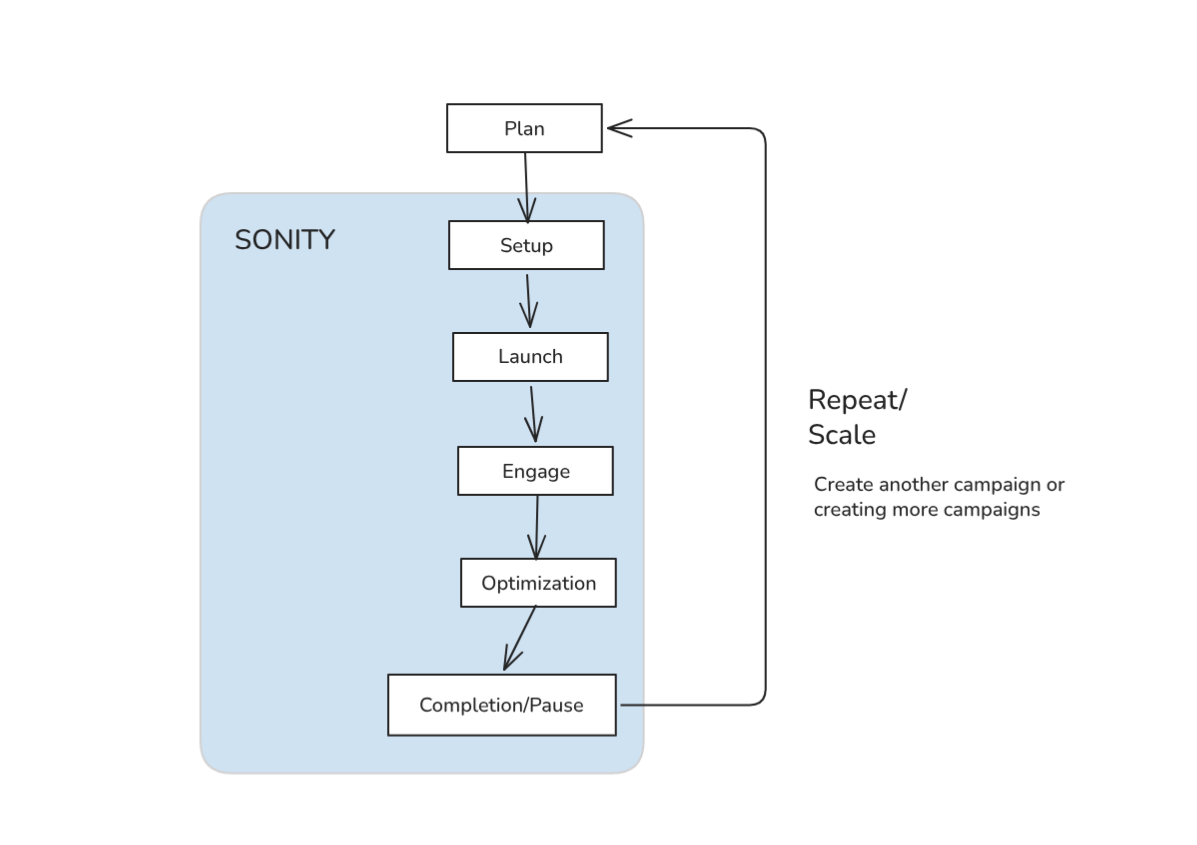
A campaign in Sonity follows a structured lifecycle, from planning your outreach to scaling what works.
Understanding this lifecycle helps you build more effective campaigns and continuously improve results.
Overview
Every campaign moves through the following stages:
Plan -> Build -> Launch -> Engagement -> Optimization -> Completion -> Repeat / Scale
This is not a one-time process. It is a loop. Each campaign teaches you something you can apply to the next.
1. Plan
This is where your campaign begins.
Define:
- Your target audience (for example founders, recruiters, developers)
- Your goal (lead generation, hiring, networking)
- Your messaging angle
A strong plan sets the foundation for everything that follows.
2. Build
Create your campaign inside Sonity.
This includes:
- Importing contacts (search, CSV, profile URLs)
- Defining your sequence:
- Connection request
- Message
- Follow-ups
- Setting delays and timing between actions
This step turns your idea into an automated workflow.
3. Launch
Activate your campaign.
Once launched:
- Connection requests are sent automatically
- Messages follow based on your defined sequence
- Activity runs within safe daily limits
At this stage, your campaign is live and running.
4. Engagement
This is where real interactions happen.
Your contacts may:
- Accept your connection request
- Reply to your messages
- Ignore the outreach
You may need to:
- Respond to replies
- Qualify leads
- Move conversations forward
This stage directly impacts your results.
5. Optimization
Review and improve your campaign performance.
Monitor:
- Acceptance rate
- Reply rate
- Drop-off points in your sequence
Adjust:
- Messaging content
- Target audience
- Timing between steps
Optimization is what turns an average campaign into a high-performing one.
6. Completion
A campaign reaches completion when:
- All contacts have been processed
- You manually stop or pause it
- Your goal has been achieved
At this point, you can evaluate results and prepare for the next iteration.
7. Repeat / Scale
Use what you have learned to improve and expand.
You can:
- Duplicate and refine successful campaigns
- Target new audiences
- Run multiple campaigns simultaneously
Scaling allows you to grow outreach while maintaining performance.
Key Takeaway
Campaigns are not static. They are iterative systems.
The most successful users continuously:
- Learn from results
- Improve their approach
- Run better campaigns over time